Homeowner guide · Energy-efficient
Low-E Coatings and Argon Gas, Explained
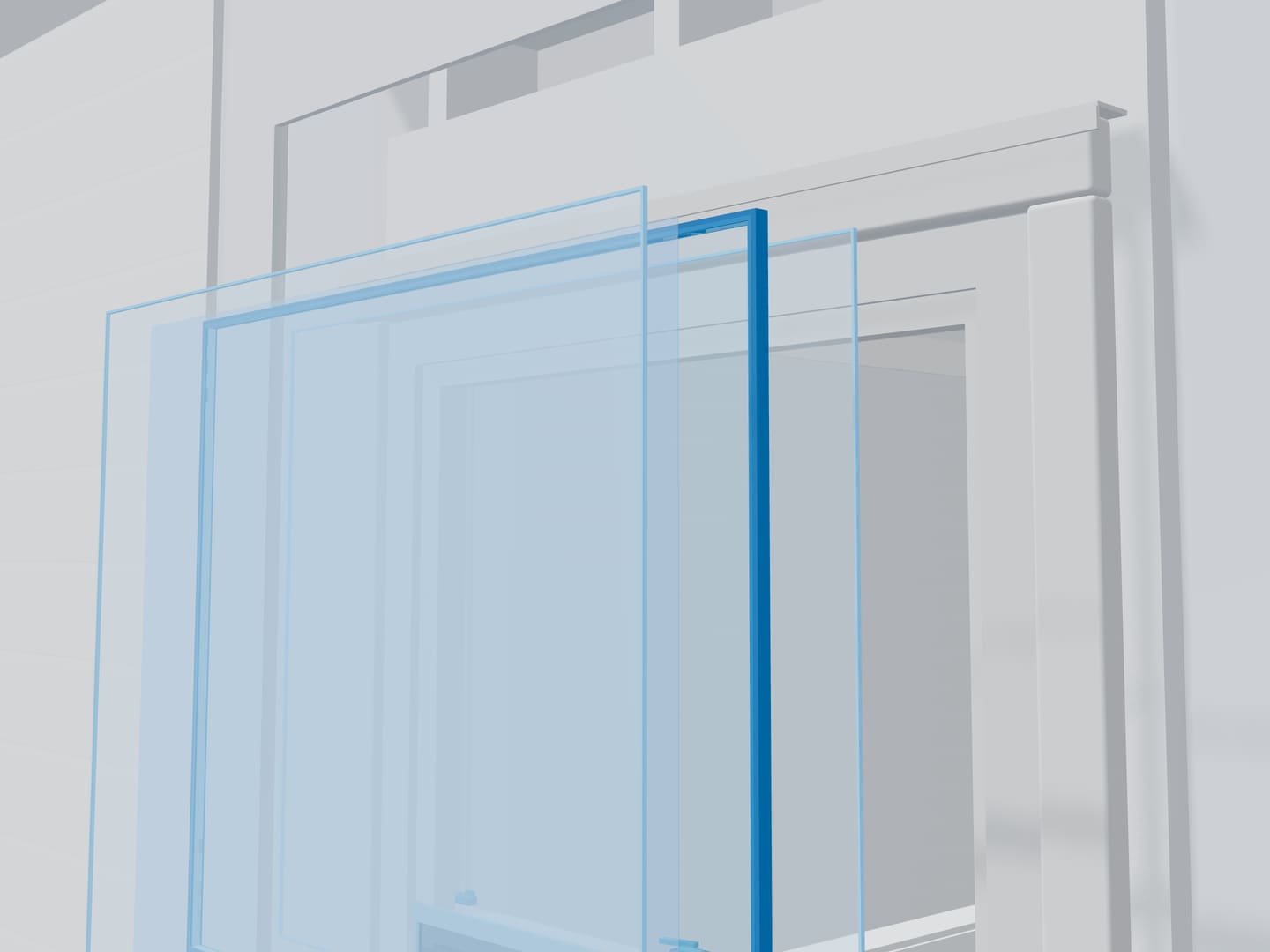
Two technologies do most of the work in a modern energy-efficient window, and you can’t see either of them. Low-E coatings control how heat moves through the glass, and gas fills slow the heat that tries to cross the space between the panes. Understanding both makes window quotes much easier to read.
How heat gets through a window
Heat crosses a window in three ways:
- Radiation, the invisible infrared heat a warm room gives off toward cold glass in winter, and the sun’s heat coming in during summer.
- Conduction and convection, heat moving through the glass, the frame and the air or gas between the panes.
- Air leakage around the sash and frame.
Low-E coatings target radiation. Gas fills target conduction and convection between the panes. Air leakage is a matter of window style, weatherstripping and installation.
Energy-efficient windows in Columbus, OH
Low‑E glass and tight frames for Ohio winters.
What a Low-E coating is
“Low-E” stands for low emissivity. A Low-E coating is a microscopically thin, nearly invisible layer, typically silver or metallic oxides, applied to one or more glass surfaces inside an insulated glass unit. The coating lets most visible light through while reflecting long-wave infrared heat. The Department of Energy’s Building America guidance describes the result: heat is reflected back to keep it out in summer and in during winter, and the coating also reflects ultraviolet rays that fade furniture and drapes.
Not all Low-E is the same
Manufacturers tune coatings for different jobs, and the difference shows up mainly in the Solar Heat Gain Coefficient:
- Coatings that admit more solar heat let winter sun warm the house while still holding indoor heat in. They suit colder climates and south-facing walls.
- Coatings that block more solar heat keep summer sun out. They suit hot climates and west-facing walls that bake in the afternoon.
- Multiple-layer coatings can push U-factor lower still, sometimes with a small drop in visible light.
Central Ohio needs some of both, which is why the ENERGY STAR criteria here differ by county. In the North-Central zone, which includes Franklin County, SHGC must be 0.40 or lower. In the Northern zone, which includes several neighboring counties, SHGC must be at least 0.17, and windows that admit more solar heat can qualify with a slightly higher U-factor. See our ENERGY STAR guide for Central Ohio.
Light and tint
Low-E glass usually looks clear, but some coatings, especially those that block a lot of solar heat, can give the glass a faint tint or reflection and lower its Visible Transmittance. If daylight matters in a room, compare VT on the NFRC label.
Where the coating goes
Glass surfaces in an insulated unit are numbered from the outside in. In a double-pane unit, surface 1 faces outdoors, surfaces 2 and 3 face each other across the sealed gap, and surface 4 faces the room. Coatings meant to limit solar heat are typically placed on surface 2, where they reflect the sun’s heat before it reaches the gap. Coatings meant to admit more solar heat while holding indoor heat in are often placed on surface 3. Either way, the coating sits inside the sealed gap, protected from cleaning and weather.
What gas fills do
An insulated glass unit has a sealed space between the panes. Filling that space with a gas that conducts heat less readily than air reduces heat flow across the gap. Two gases are used:
- Argon is the common choice. It’s inexpensive and performs well in the typical gap of about half an inch.
- Krypton performs better than argon in thinner gaps, around a quarter inch, but costs more. It appears in some triple-pane units, where thinner gaps keep the overall unit from getting too thick.
Both gases are inert, nontoxic, clear and odorless. Department of Energy guidance notes that gas fills are most effective when used together with Low-E coatings, and it advises that in colder climates, gas-filled windows with Low-E coatings reduce heat loss.
Spacers and seals: what holds it together
The spacer is the strip around the edge of the glass unit that keeps the panes apart and holds the seal. Its material affects how cold the glass edge gets in winter, which is where condensation tends to form first. So-called warm-edge spacers use less conductive materials than traditional aluminum.
The seal matters for another reason: when it fails, moisture gets into the space between the panes, the glass fogs, and the gas fill can escape. That fog is the familiar sign of a failed unit. In many windows the sealed glass unit can be replaced without replacing the whole window. See foggy window repair.
Living with Low-E glass
Because most Low-E coatings sit inside the sealed gap, everyday cleaning doesn’t touch them; clean the inside and outside faces as you would any glass. One effect surprises some homeowners: on a cool, clear, still morning, very well-insulated glass can collect dew on its outside face. The inner pane holds indoor heat so well that the outer pane stays as cold as the night air, and moisture condenses on it. It burns off as the day warms, and it’s a sign the glass is insulating, not a defect.
Can you add Low-E to existing windows?
Not by coating the glass you have. But if a window’s sash and frame are sound and its sealed glass unit has failed or is being replaced, the new unit can often be ordered with Low-E glass and gas fill. That upgrades the glass without a full window replacement. Ask about it with window glass replacement.
What to ask for in a quote
- Which Low-E coating is specified, and whether it’s tuned to admit or block solar heat.
- Whether the unit is argon or krypton filled.
- The NFRC U-factor, SHGC and VT for the exact glass package being quoted.
- Whether different glass is recommended for different sides of the house.
- What spacer the unit uses.
A1 Windows can explain the glass options on the windows we’d recommend, and you see the price before work starts. Call or text (614) 333-6302 or book online, or learn more about energy-efficient windows.
Frequently asked questions
Does Low-E glass block winter sun from warming my house?
It depends on the coating. Some Low-E coatings are designed to admit a good share of solar heat while still holding indoor heat in; others are designed to block it. The SHGC rating tells you which kind you’re getting.
Will Low-E glass interfere with my cell phone signal?
Metallic coatings can reduce radio signals passing through glass to some degree, and the effect varies with the coating, the building and the carrier. If reception is already marginal in your home, mention it when choosing glass.
Is the gas fill dangerous if a window breaks?
No. Argon and krypton are inert, nontoxic, clear and odorless, and the amount in a window is small. If the glass breaks, the gas simply mixes with the air.
Can I tell by looking whether my windows have Low-E?
Not reliably. Modern coatings are nearly invisible. The NFRC label, the order paperwork or a code on the spacer or glass may identify the glass package, and glass shops have meters that can detect a coating.
Call or text · Columbus, OH
Need energy-efficient?
(614) 333-6302- We measure before we quote
- Columbus-based · 55-mile service area
More guides
All guides
Double-Pane vs. Triple-Pane Windows for an Ohio Home
Triple-pane windows sound like an obvious upgrade for a place with real winters. Sometimes they are. But in much of Central Ohio a well-specified double-pane window already meets the ENERGY STAR criteria, so the question is what the third pane buys you in a particular room.
How to Read an NFRC Window Label
The National Fenestration Rating Council label is the closest thing windows have to a nutrition label. It turns a product’s energy performance into a handful of numbers that can be compared across brands, materials and styles.

ENERGY STAR Windows in Central Ohio: Criteria by County
Central Ohio sits on a line. ENERGY STAR assigns window criteria by county, and the counties around Columbus fall into two different zones with two different sets of rules.