Homeowner guide · Foggy window repair
Fog Between Window Panes: What a Failed Seal Means
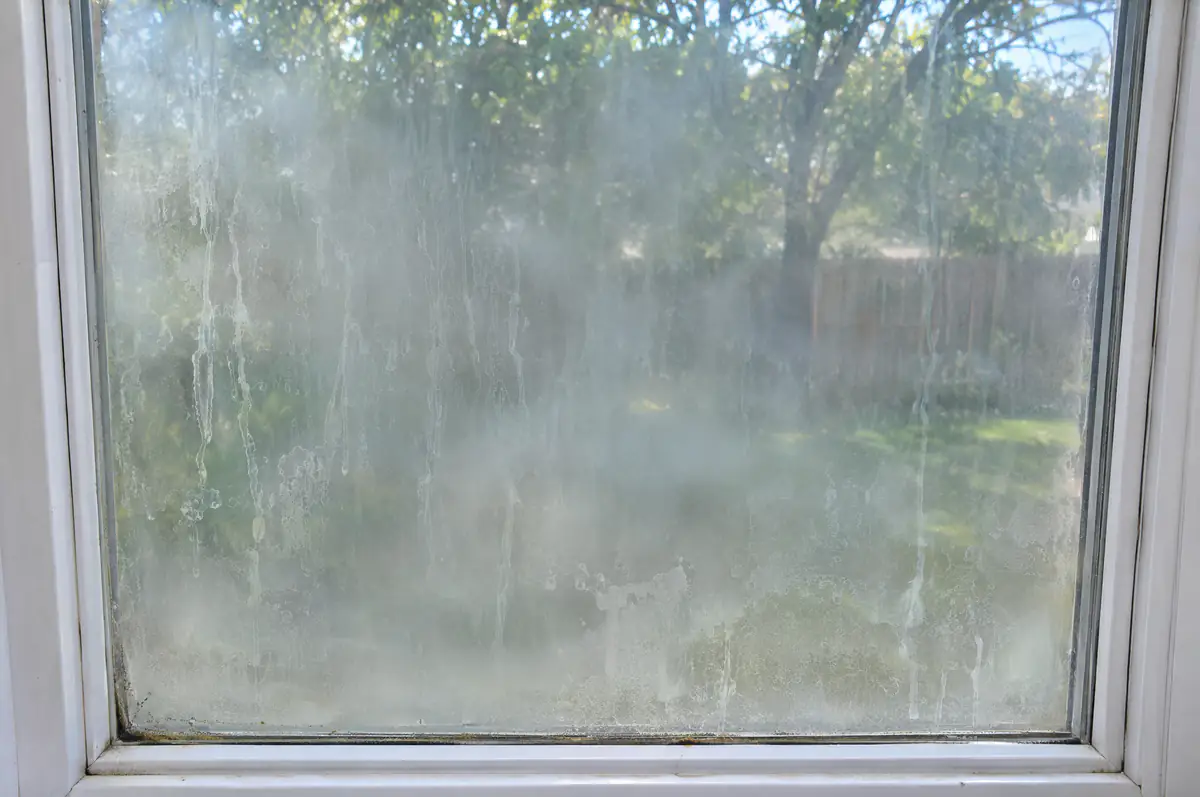
You notice it on a cool morning: a gray haze, a few droplets or a milky streak sitting in the middle of the glass. You wipe the inside. Nothing changes. You wipe the outside. Still there. When you can’t wipe the haze away from either side, the moisture is inside the sealed glass unit. That is what window people mean by a failed seal.
This guide explains how a double-pane window is built, what goes wrong when it fogs, how to be sure that is what you are looking at, and which repairs actually solve it.
How a sealed glass unit is put together
Most windows sold in the last few decades use an insulating glass unit, often shortened to IGU. It is a factory-made sandwich:
- Two or three panes of glass, held a set distance apart.
- A spacer running around the edge between the panes. The spacer is hollow and filled with desiccant, a drying agent that soaks up any moisture trapped inside when the unit is made.
- An edge seal of sealant around the outside of the spacer that keeps outside air and water vapor out.
- A gas fill in many units, usually argon, which slows heat flow better than ordinary air.
- A Low-E coating on one of the inner glass surfaces in most modern units, a microscopically thin metallic layer that reflects heat.
The whole design depends on the space between the panes staying dry and sealed. The desiccant can only absorb so much.
Foggy window repair in Columbus, OH
Foggy panes? Replace the glass, not the whole window.
What “seal failure” really is
No edge seal is perfectly airtight forever. Over years, water vapor can slowly work its way through the sealant, or it can get in quickly through a crack or a gap in the seal. As long as the desiccant keeps up, you never see it. Once the desiccant is saturated, the moisture has nowhere to go. When the glass cools below the dew point of the air inside the unit, that moisture condenses on the inner surfaces, and you see fog.
Failure usually shows up in stages:
- On and off fogging. The haze appears on cold mornings or when the sun leaves that side of the house, then clears as the glass warms. The desiccant is re-absorbing moisture as temperatures rise, but it is near its limit.
- Fog that lingers. The haze stays for most of the day and spreads across more of the glass.
- Permanent film. Repeated condensing and drying leaves a white mineral residue, streaks or a rainbow sheen on the inner surfaces. At this stage the glass looks dirty even when it is dry.
Fog is the part you can see. Two other losses tend to come with it: the argon fill, which can leak out through the same failed seal (sometimes before any fog appears), and in some cases the Low-E coating, which can corrode once it is exposed to moisture.
Make sure the moisture is really between the panes
Condensation on the room side of the glass is a different problem with different fixes, so check before you call anyone:
- Wipe the inside surface with a dry cloth. If it clears, the moisture was on the room side. Our guide to winter condensation on the inside of windows covers that.
- Wipe the outside surface if you can reach it safely. Dew on the outside of an efficient window on a cool morning is normal.
- If the haze survives both, look at the edges. Fog that starts near the spacer and spreads inward, or a white tide line along one edge, points to the sealed unit.
One more case catches people out: older homes with a separate storm window. Moisture between the storm and the main window is not a failed seal at all. It usually means warm, damp indoor air is leaking past the main sash, and better weatherstripping is the fix.
Why seals fail
- Standing water at the glass edge. Water that sits against the bottom edge of a unit attacks the sealant. Blocked weep holes in vinyl or aluminum frames, failed glazing tape and worn putty on wood sash all let it collect.
- Sun and temperature swings. Glass and spacers expand and contract every day. South- and west-facing windows work hardest, which is why fog often shows up there first.
- Age. Sealants slowly lose adhesion. A house full of windows the same age will often see failures spread from one unit to the next over a few years.
- How the unit was made and set. Thin seals, damaged edges or a unit set without proper support blocks can fail early.
Is a foggy window urgent?
Usually not. A fogged unit is still glass in a frame; it is not about to fall out, and it does not by itself make the window drafty. Drafts come from worn weatherstripping and gaps around the sash. What you lose is the view, some insulating value and, over time, the appearance of the glass. That gives you room to plan rather than rush.
The exception is a unit that is also cracked, or glass in a door or next to a tub where a break would be dangerous. Those deserve attention sooner.
The real fixes
Replace the sealed glass unit
In most cases the frame and sash are fine and only the glass package has failed. A new unit is made to the exact size and thickness, the old one comes out, and the new one is set and sealed in the same sash. This is the core of our foggy window repair work in Columbus. You can also choose a different glass package, for example adding Low-E or switching to tempered glass where safety glazing is called for.
Replace the sash or the whole window
If the frame is rotted, the sash no longer operates, or several windows of the same age are failing, replacing more than the glass can make sense. We walk through that decision in replacing the foggy glass unit or the whole window, and our window replacement page covers full units.
What about “defogging”?
Some services drill small holes in the glass, dry and clean the space, then plug the holes. That can improve the look of a unit that has not yet etched. It does not restore the original seal or put the argon back, so the unit no longer insulates the way it was built to. If you are weighing it, ask what happens to the insulating value and how the holes are sealed.
What to have ready when you call
- Which windows are affected, and whether it is the top sash, bottom sash or a fixed pane.
- The type of window: double-hung, casement, slider or picture.
- Whether the glass is in or beside a door, near a tub or shower, or low to the floor. Those spots may need safety glass, explained in tempered, laminated and annealed glass.
- Any printing on the metal spacer between the panes, which sometimes identifies when and by whom the unit was made.
A1 Windows is a Columbus company based at 1221 Stimmel Rd, serving homes within about 55 miles. A technician looks at the window before quoting, and you see the price before any work starts. Call or text (614) 333-6302, or book online.
Frequently asked questions
Can I take the window apart and clean the fog out myself?
Not in a way that lasts. The two panes, the spacer and the edge seal are sealed together at the factory, and opening the unit destroys the seal. Even if you got the glass clean, moist air would be back inside the first cold week.
Does it matter which pane of a triple-pane window is foggy?
A triple-pane unit has two sealed spaces. Fog in either one means that part of the seal has failed, and the fix is still a new unit, since the panes are built as one assembly.
Can a foggy unit be repaired in winter?
Yes. The old unit comes out and the new one goes in at the same visit, so the opening is only exposed for a short time. Measuring happens first because the new unit is made to size.
Will one failed seal cause the other windows to fail?
No. Each sealed unit is separate. Windows of the same age and exposure often fail around the same time for the same reasons, which is why one foggy window is sometimes followed by another.
Call or text · Columbus, OH
Need foggy window repair?
(614) 333-6302- You see the price before work starts
- Columbus-based · 55-mile service area
More guides
All guides
Winter Condensation on the Inside of Your Windows
Water on the room side of the glass in winter is a sign that the air in the house holds more moisture than the coldest surface in the room can handle. Most of the time the fix starts with the air, not the window.

Foggy Insulated Glass: Replace the Unit or the Whole Window?
If the frame and sash are sound, a new sealed glass unit gives you clear glass again without disturbing the trim, siding or plaster around the window. The decision gets harder when other parts of the window are wearing out too.
Double-Pane vs. Triple-Pane Windows for an Ohio Home
Triple-pane windows sound like an obvious upgrade for a place with real winters. Sometimes they are. But in much of Central Ohio a well-specified double-pane window already meets the ENERGY STAR criteria, so the question is what the third pane buys you in a particular room.